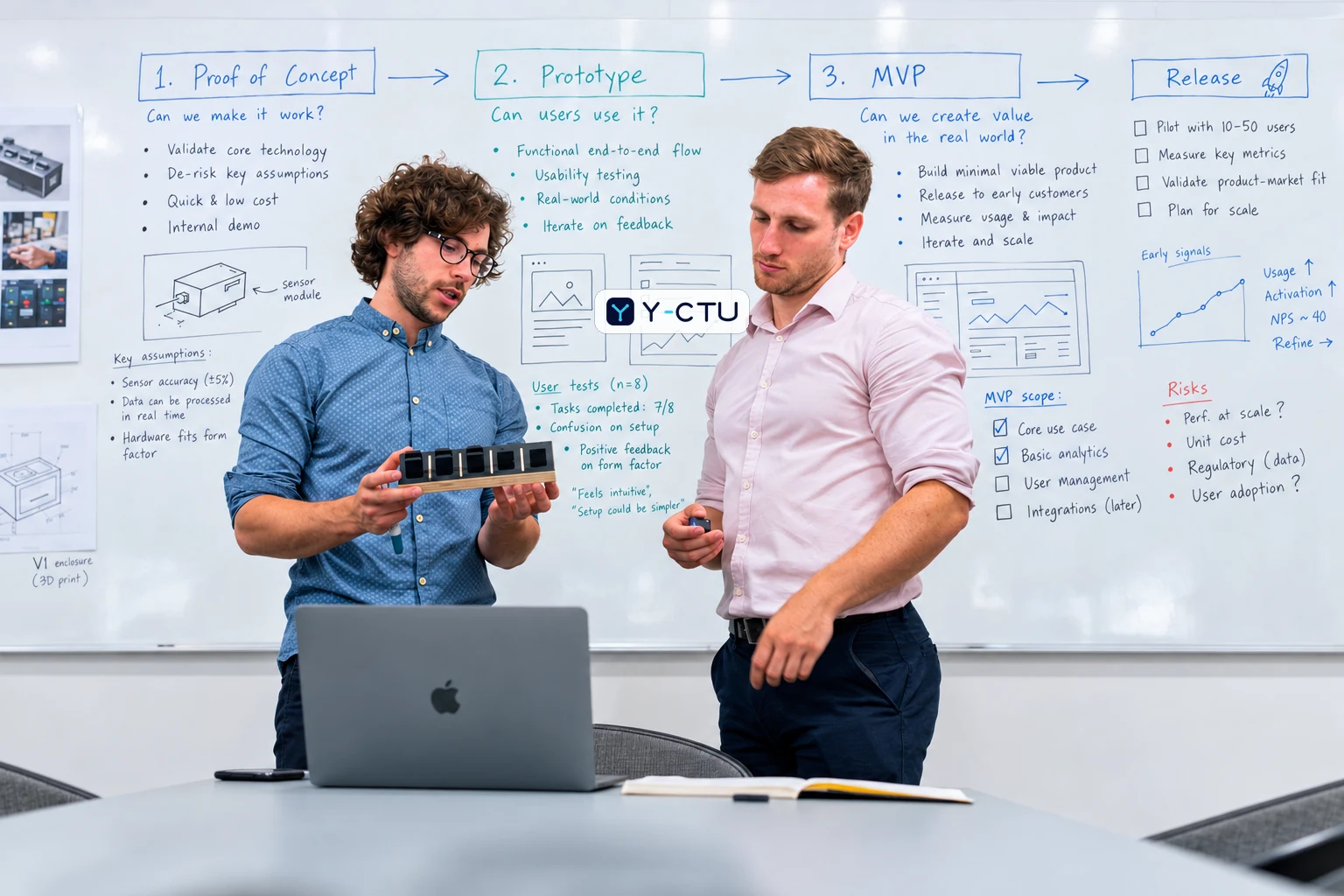
A new product idea can create three very different questions. Can the technology work? Can people understand and use the experience? Will a usable first release create enough value to justify continued investment? A proof of concept, prototype, and minimum viable product answer those questions differently.
Confusing the three can be expensive. A company may build production infrastructure before testing demand, present a clickable design as evidence that an integration works, or call an unfinished release an MVP. The right first step is the smallest experiment that reduces the most important uncertainty.
A proof of concept, or POC, is a focused technical experiment. It is useful when feasibility is uncertain: an unfamiliar integration, a difficult data transformation, an AI accuracy threshold, unusual hardware, or a demanding performance target. The audience is usually internal, and the code may never enter production.
A good POC begins with a measurable question. Instead of “test the AI,” ask whether the model can correctly classify a representative document set above an agreed threshold, within an acceptable processing time and review cost. Time-box the experiment, use realistic inputs, record limitations, and decide in advance what result means proceed, change direction, or stop.
A prototype explores the experience. It may be a paper flow, clickable design, or limited interactive interface. It lets representative users attempt real tasks before the team invests in production engineering. Prototypes are especially valuable when workflow, terminology, navigation, or trust is uncertain.
The GOV.UK Service Manual recommends prototyping early to test user needs, technology assumptions, data requirements, integrations, and likely service components. The important word is “test.” A polished mockup shown in a presentation is not evidence until people try to use it and the team records what happens.
An MVP is a live, maintainable product that delivers one complete outcome for a defined group of users. It needs the security, reliability, accessibility, monitoring, support, and data handling appropriate to its real environment. “Minimum” refers to scope, not engineering responsibility.
An effective MVP might support one customer segment, one location, or one end-to-end workflow. It should generate evidence about activation, task completion, cycle time, conversion, retention, error reduction, or another business outcome. Features that do not contribute to that learning can wait.
Every experiment needs an owner, a time limit, representative inputs, success measures, and a decision date. For a POC, evidence may be latency, accuracy, throughput, or integration reliability. For a prototype, it may be task completion, observed confusion, and qualitative trust. For an MVP, use operational and commercial measures tied to the original business case.
Avoid vanity measures. Page views do not prove that a workflow saves time. Demo applause does not prove that customers will adopt a product. A successful test changes a decision: fund, revise, pause, buy an existing solution, or stop.
Teams often overload an MVP with every role, integration, report, and edge case imagined during workshops. Start with the smallest coherent workflow, but document deferred risks. Do not defer controls required for privacy, security, accessibility, financial accuracy, or safe recovery. Reduce scope by narrowing the audience and outcome—not by making a fragile product.
A validation budget should buy a decision, not create pressure to preserve work that no longer makes sense. Keep experimental code and production commitments separate. If a POC succeeds, engineers should still review architecture, security, maintainability, licensing, and operating cost before reusing it. If a prototype tests well, the team must still design the real data model, permissions, integrations, error handling, and support process.
Estimate the next stage only when the previous stage has reduced enough uncertainty. This produces ranges that can be explained: what is known, what remains uncertain, which assumptions drive the forecast, and what evidence will narrow it. It also gives leadership useful stopping points instead of one irreversible commitment.
Be cautious when a vendor promises a production date before understanding users and dependencies, treats a visual prototype as a technical architecture, or recommends a large MVP containing every requested feature. Another warning is an experiment with no representative users, no baseline, and no predefined decision rule. Activity is not validation unless the result can change the plan.
Maintain one short evidence log containing the hypothesis, method, participants or data, result, limitations, and decision. This prevents teams from remembering only supportive feedback and gives future designers and engineers context for the choices already made.
Y-CTU helps organizations clarify product risk, prototype critical workflows, prove difficult integrations, and build secure MVPs that can evolve into dependable systems. Tell us the decision your next investment needs to support. We can help design the smallest responsible experiment and the evidence required to move forward confidently.
Editorial image: real photograph by ThisIsEngineering via Pexels; enhanced and branded by Y-CTU.